
CelGro™ is Changing Guided Bone Regeneration
Discovery rarely starts with eureka. It starts with that is odd. An Australian company with a background in orthopedics is going after the membrane market.
It has been said that discoveries in science and medicine are less often announced with "Eureka!" than with a muttered "That's funny…" Dental implantology has a famous example.
In the early 1950s, Swedish physician and researcher Per-Ingvar Brånemark was studying blood flow in bone marrow. He used small titanium chambers implanted in rabbit bone to observe the tissue under a microscope. When the experiments ended, he found he could not remove the chambers: the bone had fused directly to the titanium. He called the phenomenon osseointegration, and it became the foundation of modern titanium dental implants.
That story is a reminder of how often dental innovation borrows from other fields. Orthocell, an Australian regenerative medicine company with roots in orthopedic tissue repair, is one such case. Its collagen membrane, originally developed under the name CelGro and now sold to dentists as Striate+, is used in guided bone regeneration.
Scaffolds, Cells and Regenerative Medicine
Regenerative medicine uses biological substitutes to restore or improve the function of damaged tissue. These substitutes generally take one of three forms:
- Cell-based: healthy cells, or the growth factors they produce, are delivered to the damaged tissue.
- Scaffold-based: an implanted scaffold acts as a template, and the body's own repair processes build new tissue on it.
- Combined: cells are seeded onto a scaffold before implantation.em
Orthocell works in both of the first two areas. It makes collagen scaffolds, including its dental membrane and the Remplir nerve wrap, and it offers cell therapies for cartilage and tendon repair. Those cell therapies are not FDA-approved and are not available in the US.
How It All Started
Orthocell was founded in 2010 by Paul Anderson and Professor Ming Hao Zheng to commercialize a collagen scaffold and a set of cell therapies. Both still lead the company: Anderson as CEO and Managing Director, and Zheng as Chief Scientific Officer. Before Orthocell, the two were involved in commercializing MACI, one of the first cell therapy products for cartilage repair.
Zheng originally designed the scaffold, then called CelGro, to serve either as a biological scaffold on its own or as a vehicle for delivering cells. As development went on, the team recognized that its properties also suited a barrier membrane for guided bone regeneration (GBR). It was biocompatible and resorbable, and it could keep soft tissue cells out of a bone defect.
Brånemark's discovery was an accident. Orthocell's move into dentistry was more deliberate, an application of an existing material to a new clinical need.
From CelGro to Striate+
The dental membrane is now sold as Striate+. Orthocell still owns the CelGro name, but dentists will find the product under its new name.
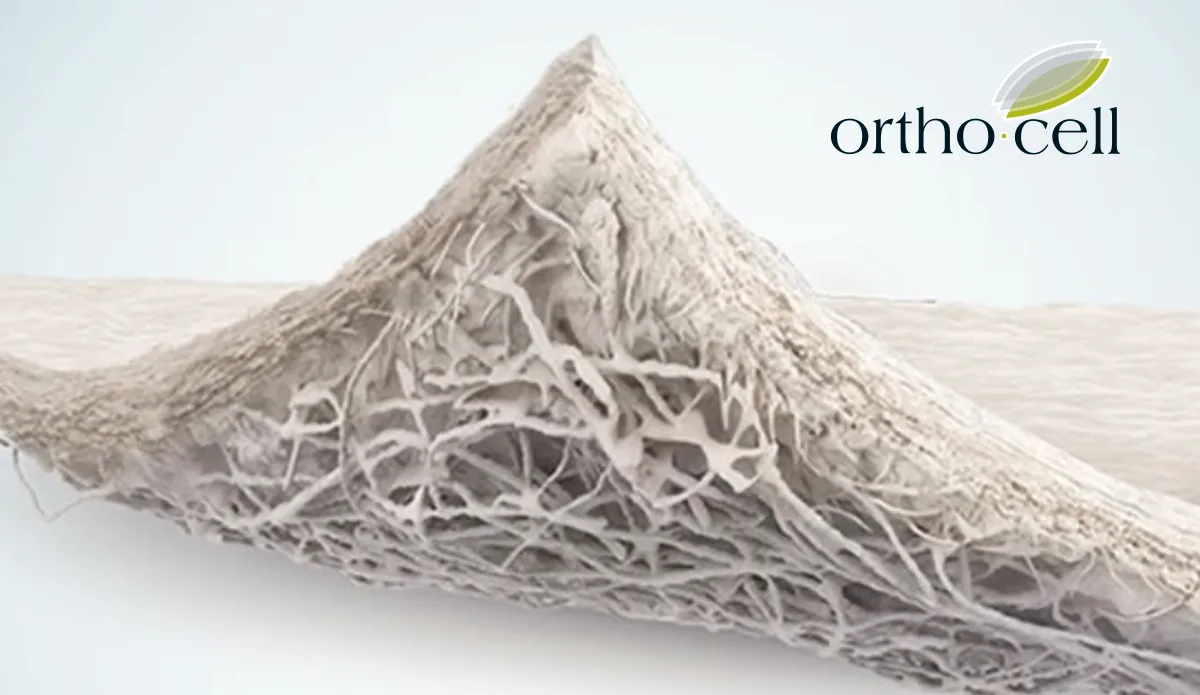
Design Striate+ is a resorbable, acellular collagen membrane. Orthocell makes it with a proprietary process it calls SMRT, which the company says preserves the natural collagen structure without chemical cross-linking. The membrane has two surfaces:
- Rough side: placed against the bone defect, where its porous fibre network is intended to support bone formation.
- Smooth side: faces the soft tissue, acting as the barrier against gingival ingrowth.
Because it resorbs, no second surgery is needed to remove it. It comes in 15 × 20 mm, 20 × 30 mm and 30 × 40 mm sizes.
Clinical Evidence
The main published human study followed 10 patients receiving 16 implants with GBR, using the membrane under its earlier CelGro name. There was no control group. The company reported enough bone regeneration for crown placement within 4 to 6 months, with no complications or adverse events. The results appeared in the journal Tissue Engineering. The study supports safety and feasibility, but it is too small to show how the membrane compares with established products.
Where Things Stand
Orthocell has moved from a pre-launch company to one with products on the market in several countries. Striate+ is sold worldwide through BioHorizons. The same collagen technology is also used in Remplir, a nerve wrap for peripheral nerve surgery that has received FDA 510(k) clearance.
For clinicians, Striate+ is one of several resorbable collagen membranes for GBR and GTR. Its non-cross-linked design and two-sided structure are its main distinguishing features. The published clinical data are limited to a small study, so membrane choice should still depend on defect size, containment and the clinician's experience.