
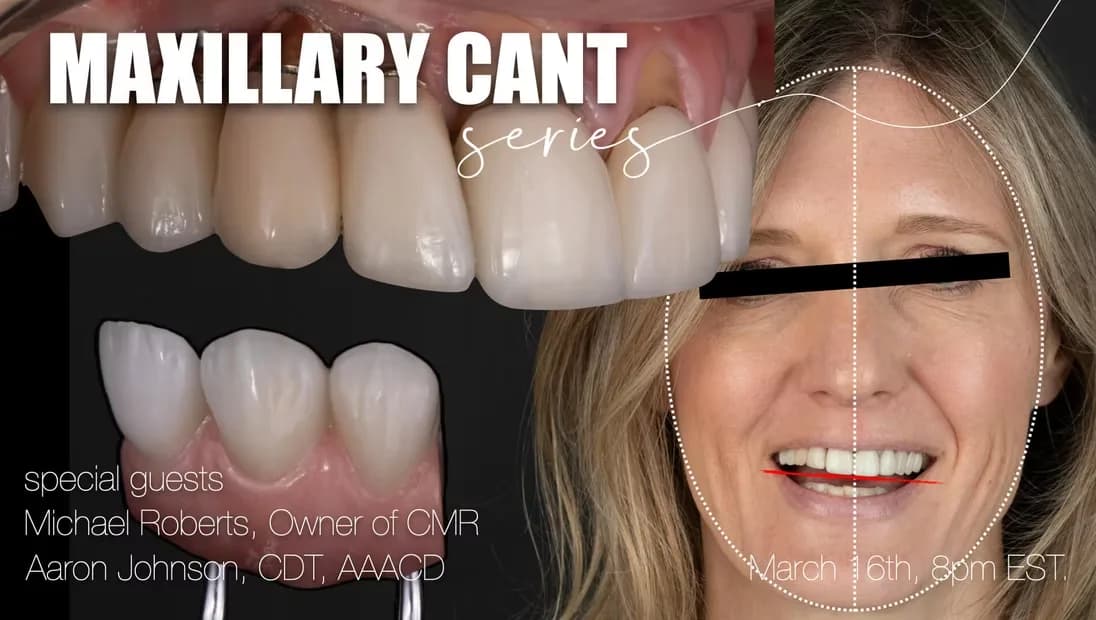
Managing an Extreme Skeletal Cant With Limited Treatment Options

No CBCT, no ortho, no expansion. The asymmetry reached her orbits, and the pupils could not be trusted as a reference.
In this case discussion, I examined one of the most complex skeletal cant presentations to come through my practice—an asymmetry so significant that it extended beyond the maxilla to the patient's orbits, eyes, and overall craniofacial structure. The challenge was not simply leveling a dental cant, but determining how to create visual balance when ideal orthodontic, surgical, and imaging options were off the table.
The patient presented with a history of trauma, implant restorations, and recession, along with a deep aversion to CBCT and any form of expansion or ortho. With only teeth #4–13 available for treatment, the question became: How do we design a predictable smile when the anatomy is extreme and the treatment parameters are narrow?
Our starting point was establishing true natural head position—crucial in a case where pupils, commissures, and even ear height were unreliable. Full‑face photos, a digital facebow, and careful rotation of the head behind the DSD oval allowed us to identify trustworthy midline and horizon references. From there, we assessed incisal display, axial inclinations, and vertical position, choosing #8 as our reference point and designing the smile curve outward from that anchor.
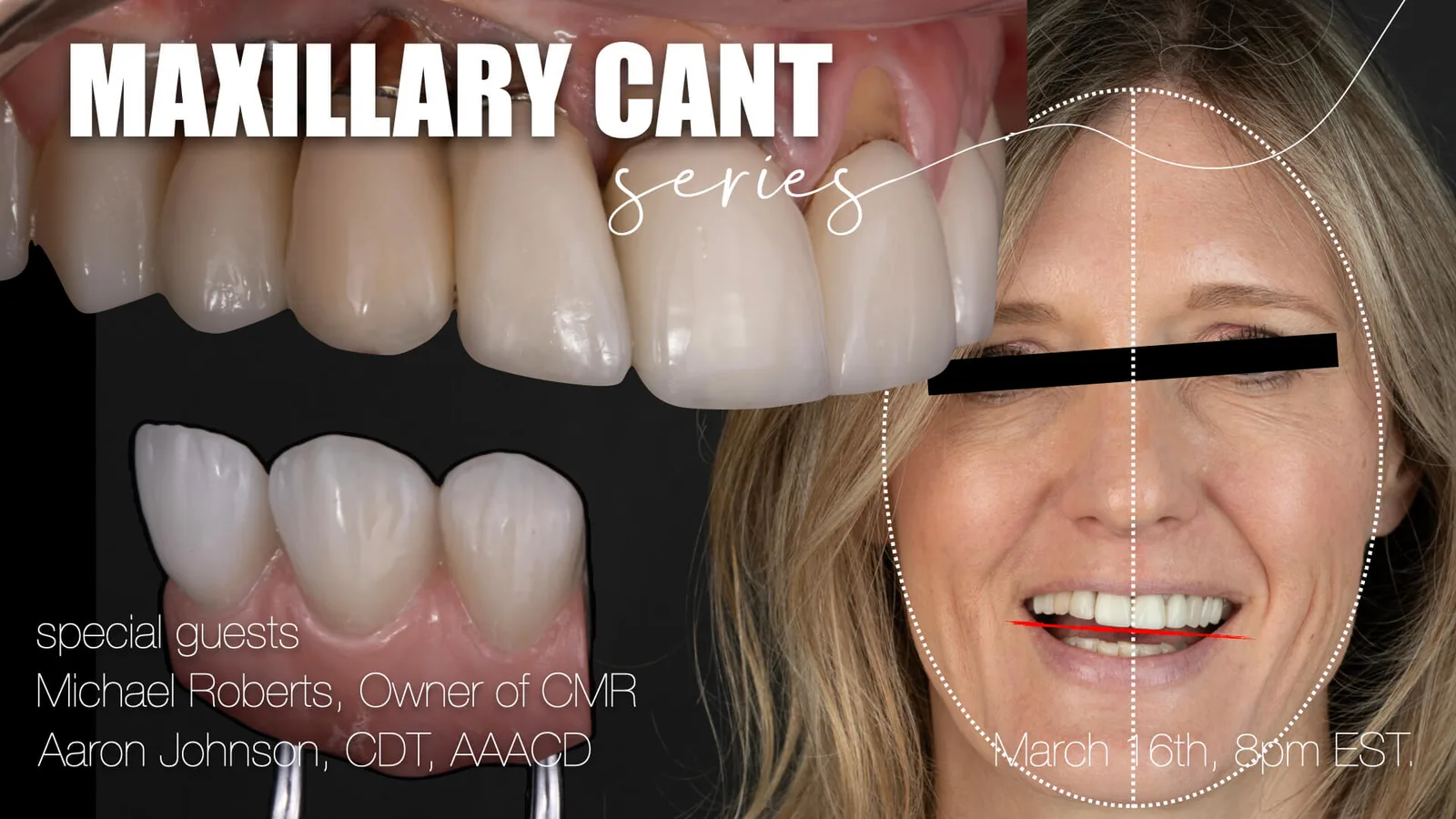
The lab's role was equally essential. With clear facially generated instructions, CMR created a design that brought the patient's right side down, tucked the canines inward to avoid lip interference, and corrected significant axial flaring without encroaching on her soft‑tissue limitations. Provisionalization allowed us to evaluate not only esthetics and symmetry, but also how well the proposed inclinations and length changes integrated with speech, lip dynamics, and function.
Pink composite was added to the temps to preview future gingival contours, and margin placement was intentionally maintained to preserve bone and grafting options long‑term. Final zirconia restorations used gradated 5Y/4Y material for warmth and strength, with careful posterior chroma to prevent the "bright premolar" effect often seen in mixed‑thickness cases.
The transformation—achieved without orthodontics, without CBCT, and without full‑arch treatment—underscored the power of consistent photography, facially driven design, and precise lab communication. Even under the most restrictive conditions, a balanced, natural smile is still possible when the diagnostic process leads the way.
Inside this case discussion:
- Learn how to establish natural head position and reliable facial landmarks when traditional cues are unreliable
- Understand why axial inclinations and canine positioning are critical for achieving balance in severe cant correction
- See how thoughtful pink/white design and clear lab communication create predictable outcomes when ideal treatment isn't possible
Seay Within's Case Continuum
- Join Monthly Live Case Discussions
- Watch Detailed Case Recordings
- 25+ Cosmetic Restorative Cases
- Step-by-step Treatment Guidance
- 5+ Hours of Clinical Tips
- Over 35 bite-sized videos
- Tips you can implement immediately
- 25+ AGD Pace-Approved CE Credits
About the Author

Dr. Amanda Seay
Charleston, South Carolina