
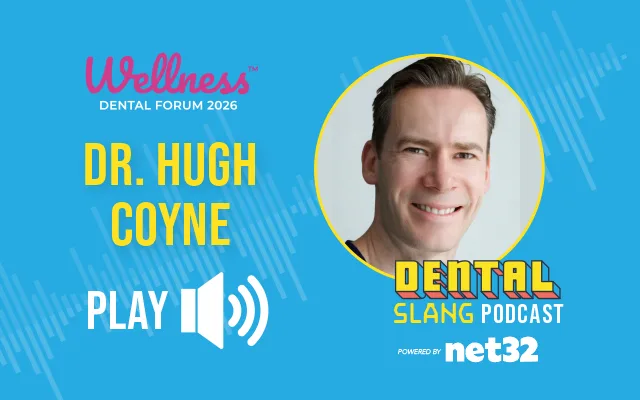
Inflammation, Lipids, and GLP-1s with Dr. Hugh Coyne

The clinician with the most consistent view of a patient's health is usually not their doctor. Dr. Hugh Coyne is a GP, and he thinks the operatory is wasted.
Here is the line that stuck with me long after we stopped recording: the clinician with the most consistent view of a patient's health is often not their doctor. It is their dentist. I sat down with Dr. Hugh Coyne, a London-based GP and co-founder of Coyne Medical, a private family practice in Fulham he built with his wife around time, prevention, and early detection. He is the son of a pediatric dentist, and it shows. I have rarely talked to a physician who thinks the way the best preventive dentists do.
What Dr. Coyne kept coming back to is that medicine and dentistry have spent a century in separate silos despite treating the same patient, and that the dental operatory is one of the most underused screening settings in healthcare. He sees the patient who feels well, presents no symptoms, and is not seeking medical care. That, he argues, is exactly the window where early detection changes the outcome, and it is a window we are sitting in every single day.
Over the hour, Dr. Coyne walked me through the core blood panel a dental practice can actually act on, the cardiovascular markers that predict risk better than standard cholesterol, the oral microbiome as an ecosystem rather than a target to sterilize, and what GLP-1 medications mean for the patient in my chair. If you have ever wondered whether systemic screening belongs in your practice, this is where I would start.
Inside This Episode
1. Dentists see the right patients at the right time to catch disease early
The idea is not new. As far back as 1891, Willoughby D. Miller, a University of Pennsylvania dental graduate, described the mouth as a focus of systemic infection. Dr. Coyne's update: periodontal disease is not a local problem. He ties it to cardiovascular disease, type 2 diabetes, and kidney disease, with oral pathogens entering the bloodstream and oral inflammation feeding systemic inflammation. So when you see advanced periodontitis in a patient who considers themselves well, you may be looking at meaningfully elevated cardiometabolic risk that no one has flagged. And as Dr. Coyne points out, patients are often more willing to be screened in the dental chair than in a medical office.
2. The core blood panel a dental practice can actually act on
Dr. Coyne's rule is to start with what is actionable. HbA1c comes first: it has the strongest evidence in dental settings, needs no fasting, catches pre-diabetes and diabetes, and affects healing, infection risk, and periodontal outcomes. Next is high-sensitivity CRP as an inflammation marker. He cites a UK Biobank analysis of over 400,000 people in which an hs-CRP above 3 carried a 34 percent higher risk of major cardiovascular events versus a reading below 1. Above 10 is a reason to pause. The core panel rounds out with vitamin D, renal function, and a complete blood count, the CBC, which UK clinicians call the FBC.
3. Vitamin D belongs with K2 before any implant surgery
Vitamin D deficiency is widespread and associated with up to a fourfold increase in early implant failure, impairing bone-to-implant contact and lowering the implant stability quotient on resonance frequency analysis. Correcting it before surgery improves outcomes. Dr. Coyne's caveat is one worth building into your protocol: vitamin D should be paired with vitamin K2, because D increases calcium absorption while K2 directs that calcium into bone and away from arterial walls. His analogy is one you can hand straight to a patient: giving vitamin D without K2 is like increasing your supply of composite without making sure it gets into the cavity.
4. The cardiac markers that beat standard cholesterol, explained with a bachelor party
What predicts cardiovascular risk, Dr. Coyne argues, is not total cholesterol but the number of atherogenic particles, captured by apolipoprotein B, with a target under 0.8. He describes lipoprotein(a) as a small, highly atherogenic particle that is roughly 90 percent genetically determined and worth checking at least once in a lifetime. His memory device for patients: HDL particles are cruise-ship tourists who wander the city and cause no trouble, while LDL is a bachelor party that talks its way past the bouncer and wrecks the bar. He frames blood pressure with a rule of halves: about half of adults have hypertension, half of those do not know, half of those who know are untreated, and half of the treated are not controlled.
5. GLP-1 medications change what you need to ask and watch for
The GLP-1 class traces back to exendin-4, a peptide found in the saliva of the Gila monster, and these drugs now reach patients you see every day, whether you realize it or not. Clinically, Dr. Coyne's headline for dentistry is that they slow gastric emptying, so a patient who appears fasted may not be, which raises aspiration risk before sedation. He adds that nausea and vomiting can drive enamel erosion, and reduced salivary flow brings xerostomia, halitosis, and higher caries risk. Because many patients will not volunteer that they are on a weight-loss medication, his advice is to ask directly, document clearly, and factor it into treatment planning.
Key Takeaways
- HbA1c is the strongest-evidence chairside blood test for dentistry, requires no fasting, and directly affects healing and periodontal outcomes.
- An hs-CRP above 3 carried a 34 percent higher risk of major cardiovascular events in a UK Biobank study of over 400,000 people.
- Vitamin D deficiency is associated with up to a fourfold increase in early implant failure, and supplementation belongs alongside vitamin K2.
- Apolipoprotein B under 0.8 and a once-in-a-lifetime lipoprotein(a) check predict cardiac risk better than standard cholesterol panels.
- GLP-1 drugs slow gastric emptying and raise aspiration risk, so screening patients before sedation is now a planning step.
Tune in to hear Dr. Coyne walk through the full core blood panel, and that bachelor-party cholesterol analogy, in his own words.
About the Author
Dr. Reza Ardalan
Port St. Lucie, Florida