
When Delta Dental Says You Can’t Bill the Patient

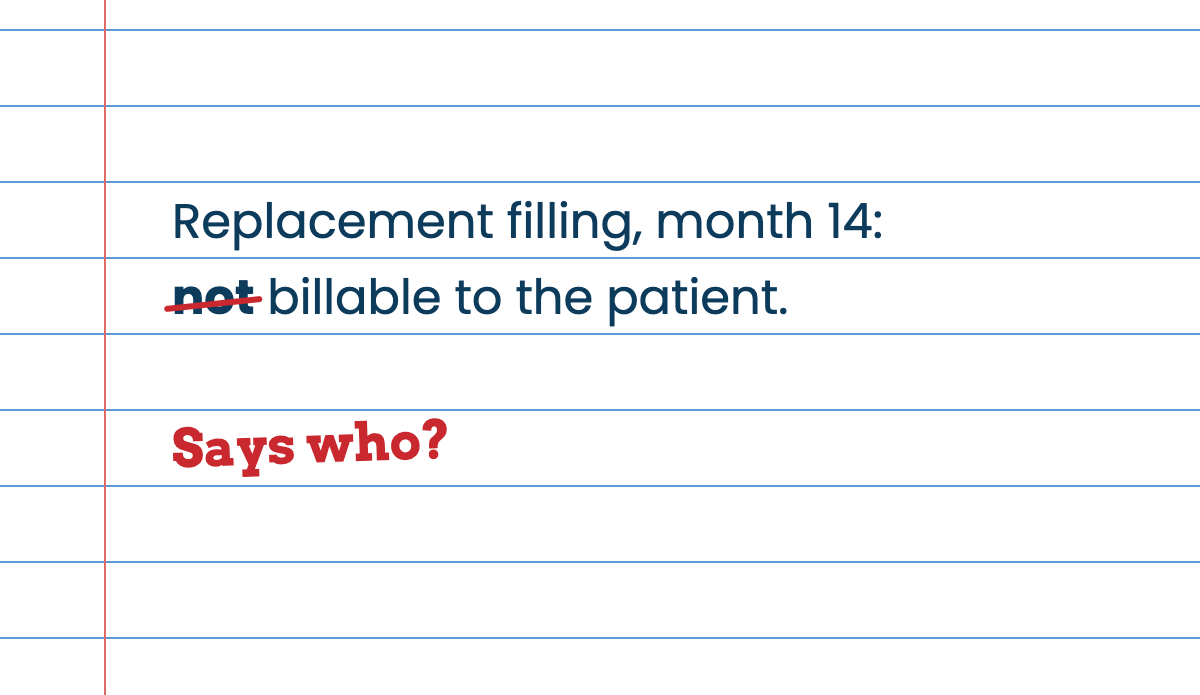
A filling fails at month 14 and the EOB says the patient owes nothing. Dr. Travis Campbell on why that EOB isn’t the final word, and how to keep it from arriving at all.
In a recent Dental Insurance Guy Office Hour, I covered one of the most frustrating policies in dental insurance right now. A patient’s filling fails 14 months after it was placed. Your office replaces it, and the EOB comes back marked not billable to the patient. Delta isn’t just declining to pay. It’s telling you that you can’t charge anyone for the work.
The question I keep getting is whether Delta can actually do that. The answer is no. Nothing in a network contract obligates a dentist to work for free. But knowing that only helps if your office acts before the claim goes out.
What Delta Is Doing
The policy treats certain repeat procedures within a frequency limit, usually 24 months, as non-billable:
- Replacement fillings on the same tooth, even when the new lesion is on a different surface.
- Crowns over recent fillings, with the filling benefit subtracted from the crown.
- Scaling and root planing on a previously treated quadrant within 2 years.
- Endodontics. In one EOB an office sent me, Delta applied the rule to a root canal that a different practice had started and never finished.
Most of us stand behind our work for a short period, usually on the condition that patients keep up with hygiene. Delta’s version goes much further. It applies across offices, providers, and surfaces, and ignores bruxism, diet, and skipped maintenance. Most replacement work has nothing to do with the quality of the original dentistry.
What You Did and Didn’t Agree To
Delta Dental is 39 separate companies that operate much like franchises. They share a brand, fee schedule, and network, but not identical contracts or policies, which is why some offices see this constantly and others never do.
More importantly, the replacement language I walked through in the session appears in the patient’s benefit policy, not the dentist’s network contract. A network contract is an agreement to a fee schedule for covered services, and I have yet to see one that requires free work. Contracts also typically define the dentist as an independent contractor, which limits how much control the insurer has over how you practice. And where a contract conflicts with state law, state law wins.
Few dentists have read their contracts closely. When I ask a room full of dentists who has, I rarely see a hand go up. In my experience, the difference that makes can reach 5% to 20% of collections.
Try the System First
My advice is always to work within the system first. Some Delta companies offer a route. Delta Dental of Washington, for example, publishes a time limit exemption form. The office documents why the replacement was needed, and the EOB should confirm the patient can be charged. Where a form exists, use it. Where it doesn’t, the fix happens before a claim is sent.
Give the Patient the Choice Up Front
My position is that patient autonomy comes first. Insurance decides what it reimburses, not what care the patient receives. So, flag the issue during treatment planning and offer 2 options:
“Your insurance won’t cover this again for another X months. You can wait, and we’ll schedule you once your coverage applies. Or, if you’d rather take care of it now, you can sign a form that keeps insurance out of this decision, and we can treat it today. Which would you prefer?”
If the patient proceeds, they sign a do not bill insurance form and pay directly, and no claim is generated. HIPAA gives patients who pay in full out of pocket the right to keep that service from their health plan, and one Delta policy I reviewed acknowledges exactly this exception. I recommend charging the network fee, which makes the decision easier for patients.
The form only protects the office when it’s used correctly. That’s why Dental Insurance Guy members get it in the download library along with access to a HIPAA course on when it applies.
Prevention Starts in the Treatment Plan
- Code for what the tooth needs. If a crown is planned and the patient defers it, the restoration is clinically a buildup. Coding it as a filling means Delta later subtracts it from the crown, and the lower out-of-pocket cost makes the patient less likely to get the crown. Cigna typically won’t pay a buildup until the crown is done, so know each carrier’s rules.
- Add an occlusal guard. For patients who clench, grind, or have broken a restoration, the guard belongs on the plan. I put one on every anterior case. If they decline and return with more damage, the earlier conversation makes paying again an easier discussion.
- Don’t overtreat to dodge the rule. The policy effectively rewards turning an incipient lesion into an MOD today. I’ve watched incipient lesions stay stable for a decade. The better answer is the patient-choice conversation.
- Be direct about perio maintenance. Patients who skip it after SRP will likely need another round that insurance won’t cover for 2 to 3 years.
If the Zero-Dollar EOB Already Arrived
Recovery is possible but harder. Many disallows are really requests for more information. A filling on a tooth with a crown on record, for example, is often flagged as a likely coding error, and a photo with a short narrative can fix it. State law can help too. When a patient at my practice escalated a zero-dollar EOB to Delta, I sent Delta the Texas statute, which now addresses disallows, and they dropped it. When insurance history is uncertain, collect in full up front and refund if coverage applies.
Prevention Is the Cure
Delta’s replacement rule isn’t a term you agreed to, and it doesn’t override a patient’s right to choose their care. Offices that see it coming and talk to the patient first rarely end up arguing about it afterward.
If you’re a Dental Insurance Guy member, you can watch the full Office Hour, Can Delta Dental Require Free Replacement Work?, on demand, along with 40+ other on-demand courses.
You can also send me your contracts and EOBs for review. Explore the Dental Insurance Guy membership.
About the Author

Dr. Travis Campbell
Plano, Texas